Thode Environmental Acoustic Lab (TEAL)
Marine Physical Laboratory, Scripps Institution of Oceanography, UC San Diego
We listen: using underwater sound to study coral reefs, whales, and the deep ocean environment
Explore Our ResearchAbout the Lab
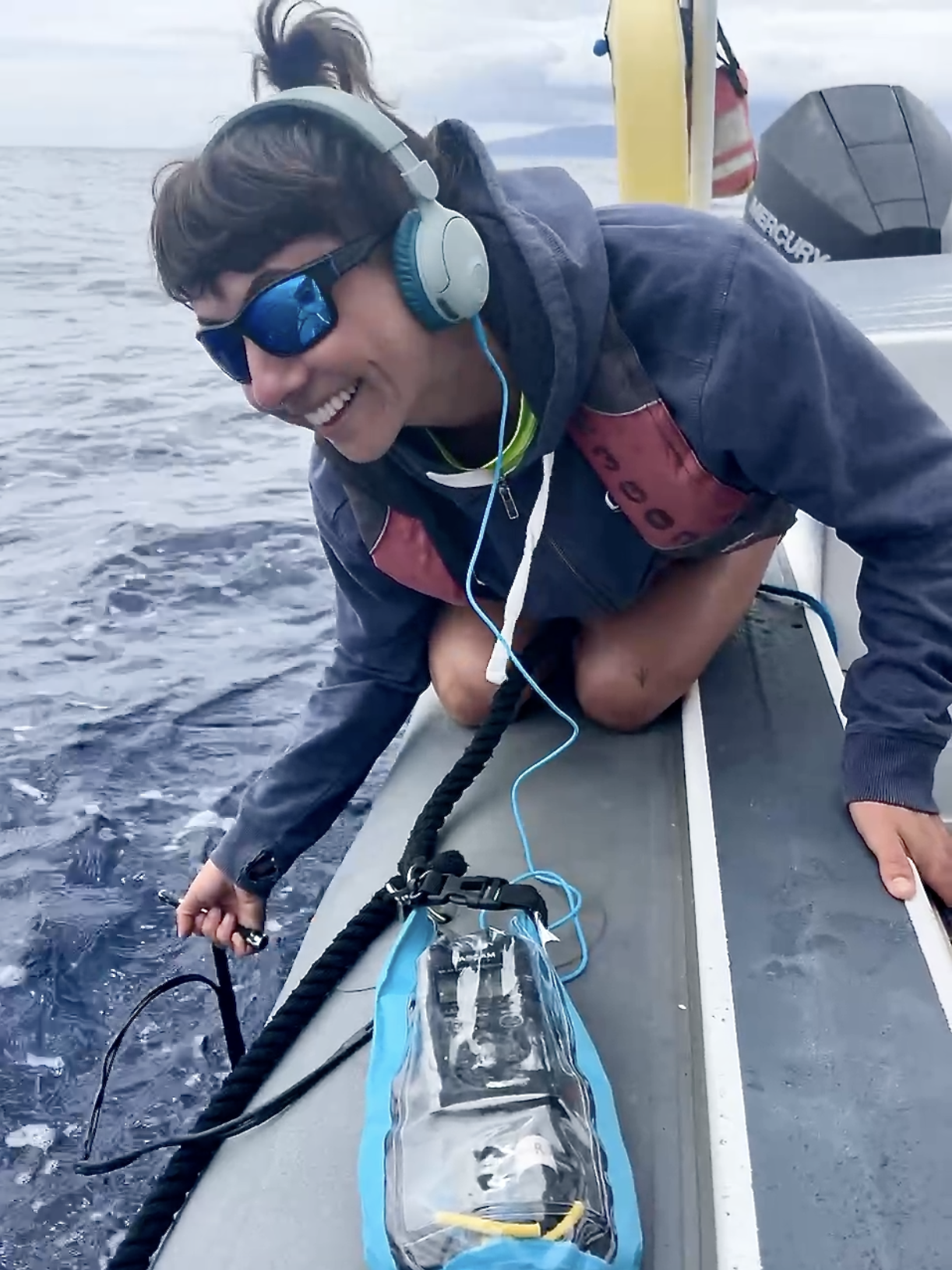
TEAL uses natural underwater sound to study the ocean environment. We specialize in using directional sensors to not only detect but localize underwater sounds from fish, whales, humans, and natural processes. Our applications range in scale from mapping 2-D fish presence over a single coral reef to tracking bowhead and humpback whales over hundreds of square kilometers. Led by Dr. Aaron Thode, the lab has developed sophisticated algorithms for acoustic localization and automated detection systems that operate even in the presence of industrial seismic surveys and shipping noise.
Read moreMost recently our lab has been exploring whether acoustic enrichment (the playback of healthy reef sounds) can help encourage settlement of fish and coral larvae on degraded or artificial structures. We employ long-endurance autonomous cameras combined with sound recordings to track fish larvae settlement and reef fish recruitment, investigating how underwater soundscapes—both natural and artificially enriched—influence larval behavior and community assembly on degraded reefs. This multifaceted approach integrates bioacoustic analysis, computer vision, and oceanographic instrumentation to address critical questions in marine conservation. From understanding whale population responses to noise pollution, or quantifying the efficacy of acoustic attraction methods for coral reef restoration, we ultimately aim to provide data-driven insights for policy makers and conservation practitioners working to protect vulnerable marine ecosystems in an era of increasing human impact.
Our Mission
To advance our understanding of marine ecosystems through innovative vector sensor-based acoustic research, long-duration underwater monitoring with autonomous integrated audio/visual systems, and applied machine learning for rapid underwater ecosystem characterization. Read more
Our work supports conservation by revealing how marine animals communicate, respond to environmental change, and interact with soundscapes in dynamic coastal and polar ecosystems. We pair field observations with signal processing, computer vision, and ecological analysis to develop practical tools for protecting vulnerable marine life and improving ocean stewardship.
Meet the Lab
Our interdisciplinary team combines expertise in marine biology, acoustics, signal processing, and oceanography.
Research Team
Graduate Students & Postdocs
A diverse team of researchers working on acoustic monitoring, data analysis, and field research projects.
Click to view team members →
Collaborators
Global Network
Working with institutions worldwide including NOAA, academic partners, and conservation organizations.
Collaborating Labs
Internal Collaborators
Scripps Institution of Oceanography
Partnering with Scripps research groups including the Multiscale Ocean Dynamics (MOD) team for innovative oceanographic instrumentation.
Featured Collaboration
Neutrally Buoyant Drifter Technology
Developing 90-m tall instrument chains for measuring ocean fine structure in quasi-Lagrangian reference frames, combining acoustic and oceanographic sensors for multidisciplinary ocean research.
Click to learn more →
Recent Publications
Over 60 publications spanning directional acoustics monitoring marine mammals, reef ecosystems, and signal processing
Support Us
If you are interested in supporting research at the Thode Environmental Acoustic Lab, please contact Dr. Aaron Thode or the Scripps Development Office for more information.
Dr. Aaron Thode
Contact Information
Mailing Address
Marine Physical Laboratory
Scripps Institution of Oceanography
UC San Diego
9500 Gilman Dr #0206
La Jolla, CA 92093-0206